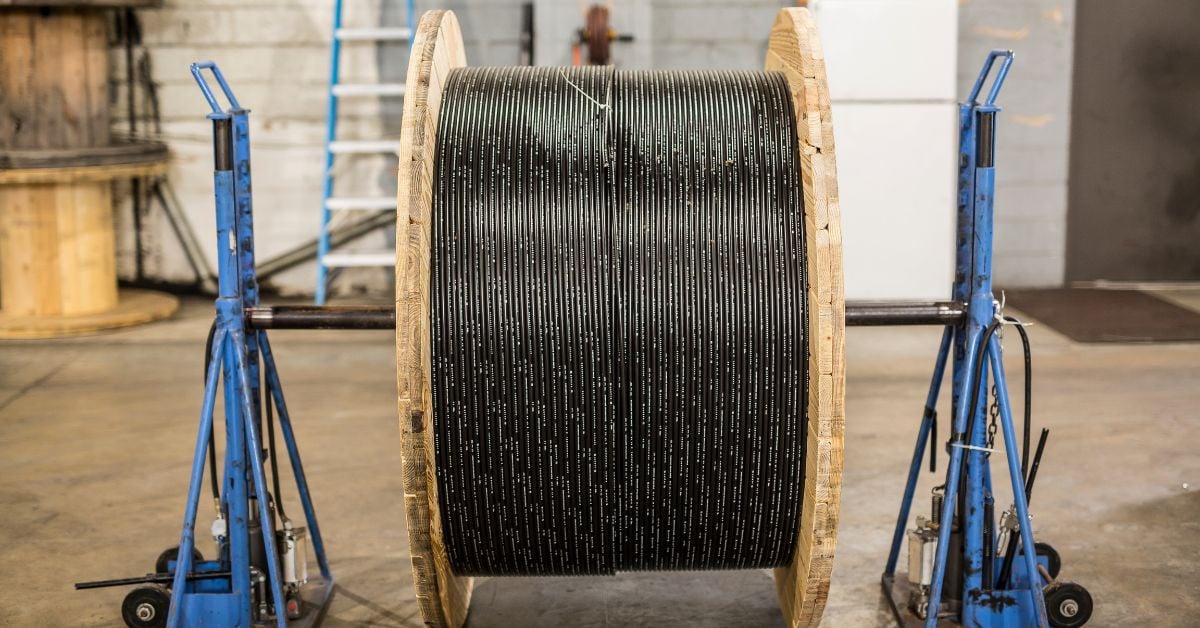
Network engineers and broadband service providers face constant pressure to deploy fiber-to-the-home (FTTH) and business networks faster, more efficiently, and with greater durability. The last mile of the network—the drop segment connecting the distribution terminal to the subscriber’s premises—often presents the most significant logistical and financial challenges. Selecting the correct cabling infrastructure for this specific segment dictates the long-term reliability of the connection and the speed of the deployment. We’re discussing various installation benefits and uses for flat drop fiber cable, highlighting its effectiveness and importance.
Understand the Flat Structure Design
The unique geometry of the cable serves a distinct engineering purpose. Unlike round cables that use a central strength member surrounded by buffer tubes, a flat drop fiber optic cable typically positions the optical fibers within a central buffer tube, flanked by two parallel strength members. These strength members, usually made of dielectric fiberglass reinforced plastic (FRP), provide exceptional tensile strength and crush resistance. This configuration creates a self-supporting structure that protects the delicate glass fibers from physical stress. The polyethylene jacket that encases these components offers protection against harsh weather conditions, chemicals, and abrasion. This design philosophy focuses on maximizing durability while maintaining a small profile, which proves essential in crowded utility spaces.
Reduce Installation Time in the Field
Labor often accounts for the largest portion of any fiber deployment budget. The construction of flat drop cable directly addresses this cost center by simplifying the preparation process. The two parallel strength members act as armor, but technicians can easily peel them away from the central tube without specialized, heavy-duty tools. Technicians spend less time accessing the fibers compared to traditional loose tube cables that may require complex shaving or ring-cutting tools. This reduction in prep time per drop accumulates significantly across a large-scale deployment involving thousands of homes. Efficiency in the field translates directly to faster project completion and reduced labor expenditures.
Simplify Aerial Deployments
Aerial drops present unique challenges regarding tension, sag, and wind loading. The flat profile of the cable offers distinct aerodynamic advantages over round cables of similar strength. The design minimizes wind resistance and reduces the accumulation of ice, which lowers the total load on the pole attachment points. Furthermore, the dual strength members allow the cable to be self-supporting over typical residential span lengths. Installers use wedge clamps specifically designed for flat profiles. These clamps grip the jacket and transfer the tension to the strength members without crushing the central buffer tube. This system eliminates the need for lashing wires or messengers for short spans, streamlining the attachment process at the pole and the premise.
 Manage Direct Buried Applications
Versatility defines the flat drop cable’s utility. The same mechanical properties that support aerial use also benefit underground installations. The rigid dielectric strength members provide the stiffness required to push the cable through micro-ducts over short distances. In direct buried scenarios, the cable offers substantial crush resistance, protecting the fiber from rock impact and soil compression. For underground tracking, manufacturers often integrate a small, copper toning wire along the edge of the cable jacket. This allows locators to energize the wire and trace the path of the buried fiber without compromising the dielectric nature of the strength members or the optical transmission.
Access Fibers With Easy Strip Features
Modern flat drop designs prioritize the technician’s experience. Manufacturers often incorporate dual ripcords underneath the jacket. A technician pulls the ripcord to slit the jacket longitudinally, allowing for clean removal of the outer sheath without damaging the internal buffer tube. Many variations also use dry water-blocking technology. Instead of sticky gels that require messy cleanup and solvents, these cables use water-swellable yarns or tapes. This keeps the work environment clean and allows the technician to proceed immediately to splicing or connectorization, further accelerating the installation workflow.
Support Broadband Last Mile Connectivity
The primary role of this cable involves bridging the gap between the distribution network and the subscriber. Its fiber count usually ranges from one to twelve fibers, with one or two fibers being the standard for residential drops. This capacity perfectly matches the bandwidth requirements for standard FTTx architecture. Whether the network uses passive optical network (PON) splitters or Active Ethernet, the flat drop cable provides a reliable transmission medium. Its single-mode fibers support the high wavelengths required for gigabit and multi-gigabit services, ensuring the physical infrastructure remains relevant as bandwidth demands increase.
Withstand Environmental Stress Factors
Outside plant (OSP) environments subject cables to extreme temperature fluctuations, UV radiation, and moisture. The materials selected for flat drop cables specifically combat these elements. The outer jacket typically contains carbon black, which absorbs UV rays and prevents the polymer from degrading and cracking over decades of sun exposure. The material composition also accounts for thermal expansion and contraction. The FRP strength members have a coefficient of expansion similar to the glass fibers. This compatibility prevents the fibers from experiencing micro-bends or strain (signal attenuation) as the cable expands in summer heat or contracts in winter freeze, ensuring consistent network performance year-round.

Optimize Inventory for Multiple Scenarios
Supply chain management benefits significantly from the dual-application nature of flat drop cable. Because the same reel can service both aerial and buried applications, network operators reduce the number of unique SKUs (stock keeping units) in their warehouses. A unified inventory strategy means construction crews carry fewer reel types on their trucks. If a specific install requires a transition from an aerial pole to an underground conduit entry, the crew uses the same continuous cable run. This eliminates the need for a transition splice point, reducing potential points of failure and signal loss while saving splice enclosure costs.
Enhance Connector Compatibility
The industry has standardized around the flat cable profile for hardened connectivity solutions. Factory-terminated flat drop cables with hardened connectors (such as OptiTap or similar proprietary interfaces) allow for “plug-and-play” deployment. Plug-and-play benefits include:
- Elimination of field splicing at the terminal.
- Reduction in the requirement for highly skilled splicing labor at the drop point.
- Faster service activation for the customer.
- Consistent, factory-tested insertion loss and return loss values.
These pre-connectorized assemblies utilize the flat profile to create a robust seal with the connector body, maintaining weather-tight integrity. This compatibility drives the widespread adoption of flat drop cable in modular network builds where speed and scalability serve as the primary metrics of success. With Millennium Broadband Solutions, access to premium-quality fiber optic drop cables is easier than ever. Use our guide about their installation benefits and practical uses and get a quote for your engineers today.