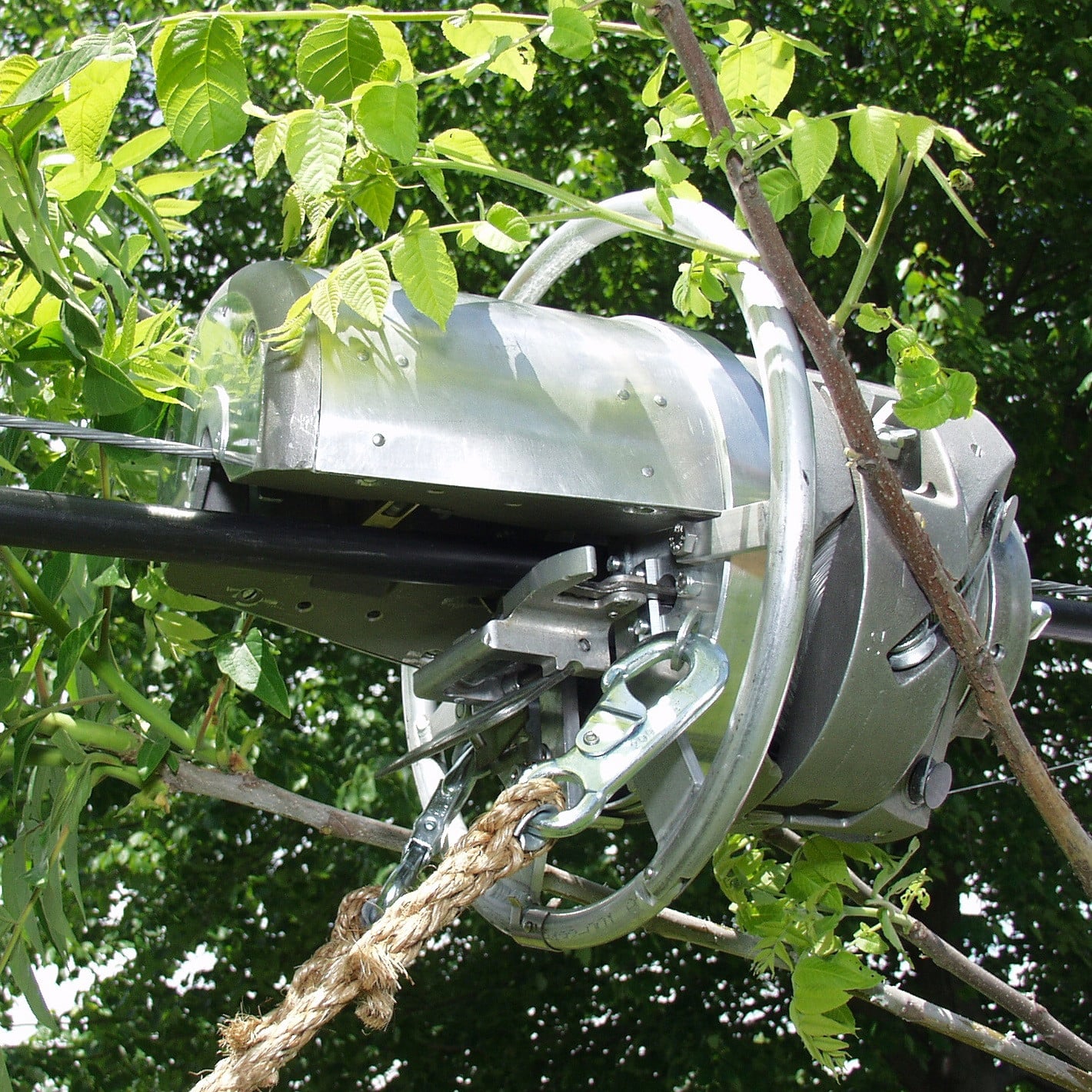
Building a reliable aerial fiber network requires more than just stringing cable from pole to pole. The physical environment presents constant challenges—wind, ice, falling branches, and thermal expansion—that threaten the integrity of delicate optical fibers. Network engineers rely on a specific method of attachment known as lashing to protect these cables. This process marries the fiber optic cable to a stronger steel messenger wire, creating a composite structure that withstands the rigors of the outside plant environment. Here’s a closer look at how an aerial cable lasher secures fiber to messenger wire.
Setting Up the Lasher on the Strand
The process begins with the preparation of the strand. The messenger wire, or strand, serves as the load-bearing member of the aerial assembly. Before the lasher even touches the wire, crews must tension the strand correctly between utility poles. If the strand sags too much, the lasher will struggle to travel smoothly; if it is too tight, it places unnecessary stress on the pole hardware. Once crews tension the strand, they mount the lasher. This machine does not sit on the ground; technicians must lift it to the aerial height. It clamps directly onto the suspension strand. The lasher features a gate or door mechanism that opens to allow the strand and the fiber cable to sit inside its central housing. The drive wheels of the lasher engage with the strand, which provides the traction necessary for the machine to pull itself forward. Without this solid mechanical connection to the messenger wire, the machine cannot function.
Loading the Lashing Wire
The lashing wire itself is a critical component. This stainless steel wire comes in compact coils specifically wound to fit inside the drum of the lasher. Technicians must load these coils into the machine’s magazines. The wire feeds through a series of tensioning rollers and guides before exiting the machine. Correctly threading the wire is essential. If the wire path is incorrect, the tension will be inconsistent, leading to loose wraps or broken lashing wire during the span. The technician secures the end of the lashing wire to the pole hardware, usually a bug nut or lashing clamp, creating a fixed anchor point. As the lasher moves away from the pole, it pulls wire from the coils, wrapping it around the stationary strand and the fiber cable.

Adjusting Tension on the Machine
Every cable lashing machine features an adjustable tension mechanism. This is not a "set it and forget it" feature. The diameter of the fiber cable bundle and the gauge of the lashing wire determine the required tension settings. If the tension is too low, the lashing wire will fit loosely, allowing the fiber cable to separate from the strand during high winds. Conversely, excessive tension can crush delicate fiber optic tubes, causing micro-bends that degrade signal transmission. Operators must calibrate the brake tension on the wire spools. This resistance ensures that the wire wraps tightly against the bundle without damaging the polyethylene jacket of the fiber cable. Experienced technicians check this tension by hand before sending the machine down the full length of the span.
Engaging the Tow Line and Drive Mechanism
The lasher requires an external force to move. While the internal gears spin the drum, the forward motion comes from a tow line attached to a vehicle or a winch on the ground. The towing bridle attaches to the front of the lasher. As the truck drives forward or the winch pulls, the tow line drags the lasher along the strand. The friction between the lasher’s drive wheels and the messenger wire converts this linear motion into rotational energy. This rotation spins the drum housing the lashing wire coils. The synchronization between forward speed and drum rotation determines the lay length—the distance between each wrap of the wire. A consistent tow speed produces a uniform wrap, which is vital for holding strength.
Wrapping the Cable Bundle
As the drum rotates around the strand and cable, it dispenses the stainless steel wire. The geometry of the machine forces the wire to spiral around the combined bundle. Because the end of the wire is anchored at the starting pole, the rotation of the drum lays the wire over the cable and strand in a helical pattern. Most lashers use two coils of wire simultaneously. This dual-lashing technique creates a double-wrap, effectively doubling the support and providing a safety factor; if one wire breaks, the second holds the cable in place. The machine ensures these two wires are spaced 180 degrees apart on the drum, resulting in an interlaced pattern that firmly binds the fiber to the steel messenger.

Inspecting the Final Lash Quality
Visual inspection follows the machine work. A properly lashed cable should sit tightly against the bottom of the messenger wire. There should be no visible gaps—often called holidays—where the cable sags away from the strand. The wire’s pitch—the distance between wraps—must be uniform. Inspectors look for:
- Slip: Evidence that the drive wheels lost traction.
- Overlapping: Areas where the wire bunched up.
- Looseness: Loops of wire that did not tighten down.
Securing Overlash Scenarios
Often, fiber deployment happens on routes that already have existing cables. This scenario, called overlashing, involves adding a new fiber cable to an existing bundle that is already lashed to a strand. The mechanics remain largely the same, but the lasher must accommodate a larger total diameter. The machine does not remove the old lashing wire. Instead, it wraps new wire over the entire assembly—the strand, the old cables, and the new fiber. This creates a thicker bundle. Operators must adjust the gate size on the lasher to fit the larger mass.
Maintaining the Lasher for Performance
The reliability of the lashing operation depends directly on equipment maintenance. A seized bearing or a worn drive wheel can halt construction. Routine maintenance ensures the lasher operates correctly in the field. Key maintenance tasks include:
- Cleaning: Removing grease, dirt, and zinc buildup from the strand.
- Lubrication: Applying oil to chains and gears to prevent rust and reduce friction.
- Brake Inspection: Checking the wire spool brake pads for wear.
Field crews must keep the internal raceways free of debris. If dirt clogs the mechanism, the drum will not rotate smoothly, causing lashing irregularities. Consistent maintenance schedules prevent costly downtime and ensure every foot of fiber is secured to the highest industry standard. Millennium Broadband Solutions provide network engineers and contractors with industry-trusted equipment and tools. Take a look at our lashers and don’t hesitate to partner with our professionals to discuss further how an aerial cable lasher secures fiber to messenger wire.